Showing posts with label islam. Show all posts

Pre-Islamic Arabia

Pre-Islamic Arabia
Pre-Islamic Arabia

Arabia, which spans an area of 1.25 million sq. miles, is a rugged, arid, and inhospitable terrain. It consists mainly of a vast desert, with the exception of Yemen on the southeastern tip, a fertile region with ample rain and well suited for agriculture.

The southwestern region of Arabia also has a climate conducive to agriculture. The first mention of the inhabitants of Arabia, or “Aribi,” is seen in the ninth century b.c.e., in Assyrian script. The residents of northern Arabia were nomads who owned camels.

In pre-Islamic Arabia, there was no central political authority, nor was there any central ruling administrative center. Instead, there were only various Bedu (Bedouin) tribes. Individual members of a tribe were loyal to their tribe, rather than to their families.


The Bedu formed nomadic tribes who moved from place to place in order to find green pastures for their camels, sheep, and goats. Oases can be found along the perimeter of the desert, providing water for some plants to grow, especially the ubiquitous date palm.

Since there was a constant shortage of green pastures for their cattle to graze in, the tribes often fought one another over the little fertile land available within Arabia, made possible by the occasional desert springs. Since warfare was a part of everyday live, all men within the tribes had to train as warriors.

By the seventh century b.c.e. Arabia was divided into about five kingdoms, namely the Ma’in, Saba, Qataban, Hadramaut, and Qahtan. These civilizations were built upon a system of agriculture, especially in southern Arabia where the wet climate and fertile soil were suitable for cultivation.

Of the five kingdoms Saba was the most powerful and most developed. Until 300 c.e. the kings of the Saba kingdom consolidated the rest of the kingdoms. Inhabitants of northern Arabia spoke Arabic, while those in the south spoke Sabaic, another Semitic language.

As Yemen lay along a major trade route, many merchants from the Indian Ocean passed through it in south Arabia. The south was therefore more dominant for more than a millennium as it was more economically successful and contributed much to the wealth of Arabia as a whole.

By the seventh century b.c.e. the oases in Arabia had developed into urban trading centers for the lucrative caravan trade. The agricultural base of Arabia contributed to the economy of Arabia, enabling inhabitants to switch to economic pursuits in luxury goods alongside an ongoing agrarian economy.

The commercial network in Arabia was facilitated mainly by the caravan trade in Yemen, where goods from the Indian Ocean Basin in the south were transferred on to camel caravans, which then traveled to Damascus and Gaza.

Arabia dealt in the profitable products of the day—gold, frankincense, and myrrh, as well as other luxury goods. The role of the Bedu, likewise, evolved. Instead of just being military warriors engaged in tribal rivalries, they were now part of the caravan trade, serving as guardians and guides while caravans traveled within Arabia. These Bedu were different from other nomadic tribes, as they tended to settle in one place.

Assyrians, followed by the neo-Babylonians, and the Persians disturbed unity in Arabia. From the third century c.e. the Persian Sassanids and the Christian Byzantines fought over Arabia. Later on, just before the rise of Islam, there emerged two Christian Arab tribal confederations known as the Ghassanids and the Lakhmid.

The city of Petra in northwest Arabia was under the control of the Byzantines (through the Ghassanids), followed by the Romans, while the northeastern city of Hira fell under Persian influence (the Lakhmid). Under the Lakhmid and Ghassanid dynasties Arab identity developed, as did the Arab language.

The central place of worship for the nomadic Bedu tribes was the Ka’ba, a cubic structure found in the city of Mecca, which houses a black stone, believed to be a piece of meteorite. The Ka’ba was the site of an annual pilgrimage in pre-Islamic Arabia.

Abraham first laid the foundations of the Ka’ba. Over a millennium the function of the Ka’ba had drastically changed and just before the coming of Islam through Muhammad, idols were found within the shrine.

The Bedu prayed to the idols of different gods found within. Although the various nomadic Bedu tribes often formed warring factions, within the sacred space of the Ka’ba, tribal rivalries were often put aside in respect for the place of worship. Mecca became a religious sanctuary and a neutral ground where tribal warfare was put on hold.

By the seventh century c.e., besides being an important religious site, the city of Mecca was also a significant commercial center of caravan trade, because of the rise of south Arabia as a mercantile hub. Merchants of different origins converged in the city.

Just before the rise of Islam, the elite merchants of the Quraysh tribe led Mecca loosely, although it was still difficult to discern a clear form of authoritative government in Mecca. Mecca, like southern Arabia, was home to many different people of various faiths.

Different groups of people had settled in Arabia, especially in the coastal regions of Yemen, where a rich variety of religions had coexisted, having originated from India, Africa, and the rest of the Middle East.

This is because of its strategic location along the merchant trade route from the Red Sea and the Indian Ocean. They were Jews, Christians, and Zoroastrians who had migrated from the surrounding region.

These migrants were markedly different from the indigenous inhabitants of Arabia in that they adhered to monotheistic faiths, recognizing and worshipping only one God. Thus, the inhabitants of pre-Islamic Arabia were familiar with other monotheistic faiths prior to the coming of Islam, however, subsequent Muslim society would refer to those living in pre-Islamic Arabia as living in jahiliyya, or “ignorance.”

Hagia Sophia

Ancient Byzantine church, Hagia Sophia

The cathedral church of Constantinople, built on the ruins of an earlier church, dates back to the fourth century c.e. hagia sophia in Greek means "holy wisdom", referring to the holy wisdom of God, a theological concept much discussed in religious traditions.

The original church was destroyed by fire in 532 during a massive riot against the government of Emperor Justinian I (527–565 c.e.). Justinian restored order and commanded the construction of Christendom’s then greatest church.

The plan was designed by architects Anthemios of Tralles and Isidore of Miletos and took, according to one source, two teams of 5,000 workers five years to complete. The magnificence of the church was apparent upon its consecration in 537, when Justinian reportedly declared, "O Solomon [the legendary builder of the Temple in Jerusalem], I have outdone thee!"


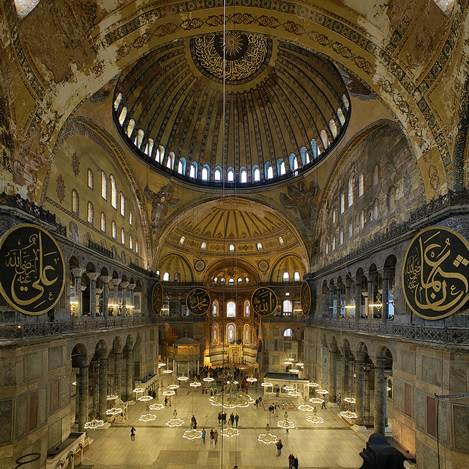
The church is approximately 250 feet long, 230 feet wide, and sits beneath a dome 100 feet in diameter that reaches nearly 185 feet from the ground. The dome rests on four arches (themselves supported by four massive piers).

Beneath the dome are openings that let light in, creating an appearance that the dome rests on air, held up by heaven itself. The dome’s design was extremely bold and suffered as a result, collapsing in 558. The dome was repaired but was susceptible to damage by earthquakes in subsequent centuries.

Hagia Sophia radiated Orthodox Byzantine power and wealth. Its interior mesmerized onlookers with the sparkle of a ceiling covered in gold, a sanctuary adorned by 40,000 pounds of silver, glowing mosaics, and decorative marble, all of which proclaimed the glory of Byzantium.

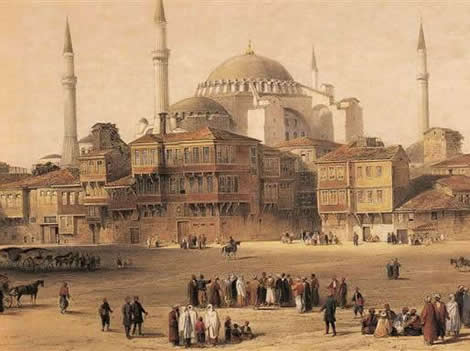
Ottoman mosque, Aya Sofya (1852)

For building this church, the memory of Emperor Justinian in the Byzantine mind was outdone only by that of Constantine the Great, who built Constantinople. A mosaic in the Hagia Sophia’s narthex depicts each emperor offering his monument to the Virgin Mary holding the Christ Child. Constantinople and Hagia Sophia came to epitomize Byzantium for the next millennium of Byzantine history.

As the church of the Orthodox Patriarch, Hagia Sophia served as the liturgical center of Constantinople and the Byzantine Empire. It also played a central role in the empire’s political life as the location where the patriarch crowned each new emperor.

It also played an essential part in imperial processions and the expression of Byzantine power to foreign ambassadors. The sight of the Hagia Sophia impressed visitors from Western Christendom, the Slavic lands, the Muslim world, and the various tribes of the north.


When, in the 10th century, for example, Russian visitors sent by Vladimir of Kiev visited Constantinople, the emperor sent them to behold the worship in the cathedral (expecting them to be impressed).

In fact, they were so mesmerized by the experience, they declared that were uncertain whether they were in heaven or on earth. Vladimir and the Russians soon converted to Orthodox Christianity.

The cathedral remained the great monument of Orthodox Byzantium until 1453, when the Ottoman Turks conquered Constantinople under Sultan Mehmet II. The sultan converted it into a mosque, adding minarets. When the Ottoman Empire ended in the early 20th century, Turkish ruler Kemal Atatürk converted the building into a museum.

Inside (*just*) secular museum, Hagia Sophia

Biblical Patriarchs

Abraham begins the discussion of the Patriarchs and, indeed, of the three modern world religions. The record of his life is found in the Jewish scriptures and is largely reaffirmed in the New Testament of the Christians and assumed by the Qur’an.

After Abraham the interpretation of the other biblical Patriarchs head in different directions, with the Jews and the Christians paying heed to Abraham’s second-born son, born of his wife Sarah, and the Muslims following the line of Ishmael (Arabic: Ismail), Abraham’s first-born son, born of his female slave Hagar.

The details of Abraham’s life in the Jewish Bible are sometimes sketchy, sometimes biographical. Abraham came from the Fertile Crescent, wandering from Ur to Harran (Carrhae), in the region of Edessa.

His travels conform to known Amorite migratory patterns, and his lifestyle as a shepherd or trader also was consistent with the Mesopotamian world of the 20th–17th centuries b.c.e. He received a divine command to continue his journey farther into the far-flung corner of the Fertile Crescent, to the land of Canaan.


He was promised many descendants and much land. Though the promises are repeated several times, the biblical narrative tells of Abraham’s frequent trials and travails, which ultimately prevent him from realizing the fulfillment of the divine promise.

First, as Abraham waited many years for a descendant to be born, he attempted to establish his own family line by selecting his chief servant to be heir. Then, after decades of waiting, he begot a son through his wife’s Egyptian servant—an ancient custom in Mesopotamia.

This son was called Ishmael, and he is the one that Muslims revere as the beginning of the line leading to their prophet Muhammad. Only when Abraham had nearly reached the age of 100 did his elderly wife bear a son, whose name was Isaac, through whom the nation of Israel would flourish.

Though Abraham had at least one other son by another woman, no others fit into the divine promise. For Jews and for Muslims, it is only one son (either Ishmael or Isaac) upon whom the promise devolves.

Second, as the only son of the divine promise grew older, the Hebrew God ordered Abraham to make a child sacrifice to him. Abraham dutifully obeyed, and was prevented at the last minute from executing his fatal sacrificial blow.

The Jewish Bible names this son as Isaac, but the Qur’an says that he was Ishmael. Both the Jewish and Islamic faiths venerate the place where the human sacrifice would have occurred (for Jews, Jerusalem; for Muslims, Hira) as a site of pilgrimage or holy ground.

Third, Abraham spent his life as a pilgrim and resident alien in the land of Canaan, owning no land though his promised expanse included the territories southwest of the Euphrates all the way to the Mediterranean Sea (modern-day Syria, Turkey, Lebanon, Israel, and Palestine).

When his wife died some 37 years after the birth of Isaac, he had nowhere to bury her in this "promised land", until he negotiated for property from the local people. Though he was wealthy and respected, he died at age 175 without any land for his own burial, save his wife’s tomb.

Jews, Christians, and Muslims all claim a share in Abraham’s life, but historians also take into account what holy books teach about Abraham. Some of the main issues include monotheism, pilgrimage, and chosen people and lands. Out of polytheistic Mesopotamia Abraham was called to worship one transcendent divinity not connected to nature—this is monotheism.

He left his Fertile Crescent home, his family, and his ethnic identity—this is pilgrimage. He maintained his unique claim to a new land and ethnic identity—that he chose. And all three of these elements are pillars of each of the "Abrahamic" religions.

Ishmael would have been the recipient of his father’s favor and wealth, as the first-born. However, Isaac’s jealous mother drove him and his mother out of the camp. Nonetheless, the Bible gives a generally favorable impression of him: he was father of 12 sons, who were in turn the progenitors of 12 tribes—like the Patriarch of Israel, Jacob.

He was present at his father’s burial. His ancestors are depicted as nomads and associated with Israel’s neighbors and therefore not recipients of Abraham’s divine promise.

According to the New Testament, Isaac symbolizes that the divine promise is not by blood but by divine grace and sovereignty. Muslims reject this interpretation and see in the jealousy of Isaac’s mother her recognition that the promise is upon Ishmael.

Isaac’s life was lived in the shadows of his father, Abraham, and his famous son Jacob. Only two later-life events are narrated: his marriage, arranged by his father, and his death-bed testament, manipulated by his son.

One-quarter of Genesis focuses on Jacob, and there is much material that corroborates with what is known of the second millennium b.c.e. The picture of him is not altogether flattering. He was born clutching his older brother’s heel, as if he was reluctant to let him be first born.

He manipulated his brother out of his inheritance, tricked his father out of his deathbed blessing, and struggled with a divine being to obtain his own ends. When he tried to barter for a wife in Mesopotamia, he tasted the bitterness of his own medicine as he was cheated out of work, wife, and time.

Through his wives Jacob had 12 sons, all of whom became leaders of the 12 tribes of Israel. Before Jacob’s days ended he endured one more draught of the poison that he had brewed in his youthful days. His sons carried out a conspiracy to sell his favorite son into slavery and concealed it by blaming his disappearance on wild animals.

Only in his twilight years, after Jacob has been forced to leave the "promised land", did he find out that his favorite son was alive. From ancient Egypt Jacob delivered his final speech, speaking of his implicit faith that he would be buried in Canaan. His speech is some of the oldest poetry in the Bible.

The favorite son, sold as a slave to Egypt, was Joseph, the final Patriarch of the Bible. Joseph’s story makes up 25 percent of Genesis, but he is rarely mentioned outside this book.

Once Joseph is in Egypt he ascends to the highest office in the land, steward to the pharaoh. From that position he is able to provide refuge for his starving family, who comes from Canaan to Egypt.

Its literary role is to bring the Jewish salvation history to Egypt, where Moses will arise and lead the people out of Egypt. Yet the story also has a religious message: Repentance and forgiveness can save even the most dysfunctional and divided family.