Cyclades

Cyclades islands map

The Cyclades, because of their central location to trade in the eastern Mediterranean, have a rich and long history. They are a part of the vast number of islands that constitute the Greek archipelago in the Aegean Sea. The name was originally used to indicate islands that formed a rough circle around the sacred island of Delos.

The Cyclades are comprised of around 220 islands, with the major ones being Amorgos, Anafi, Ándros, Antiparos, Delos, Ios, Kéa, Kimolos, Kynthos, Mílos, Mykonos, Náxos, Páros, Pholegandros, Serifos, Sifnos, Sikinos, Síros, Tínos, and Santorini (Thíra).

While ancient maritime trade made the region important strategically and geographically, a reliable agricultural base made life on the Cyclades archipelago possible. The Cyclades may have been one of the earliest sites of the worship of the Mother Goddess cult, which became widespread throughout the eastern and western Mediterranean.


All Mediterranean and Middle Eastern cultures including ancient Mesopotamia, Egypt, and later on, Greece, would feature prominent goddesses. When the Minoan culture flourished in the islands from about 3000 to 1450 b.c.e., frescoes on the walls of the palace, excavated by the British archaeologist Arthur Evans, featured a bare-breasted goddess with snakes.

Snakes figured in many of the Mother Goddess cults in antiquity and had its parallel in the story of Eve and the serpent in the Garden of Eden in the Old Testament. Settlement of the Cyclades was sporadic. The Phoenicians were most likely the first settlers, while around 1000 b.c.e. the island was inhabited by the Ionians. In the case of Síros, ancient ruins, statuettes, and skeletons indicate the island had been settled by the Bronze Age.

The very dispersion of the islands made seafaring a necessary part of survival, as islanders learned that they could gain by trading with—or raiding—other islands in the archipelago.

It is in these early boats that one can find the beginnings of the oared galleys that would be a feature of Mediterranean warfare until the 18th century at least, when the Knights of Malta used huge galleys in their wars against the Barbary pirates. Cycladic ships were the prototypes with which ancient Greece would plant its colonies, beginning around the sixth century b.c.e., and with which Rome would become the mistress of the Mediterranean.

The Cycladic culture peaked during the Minoan period, which was brought to life by the work of Arthur Evans with his reconstruction of the royal palace at Knossos. The story of European civilization begins on the island of Crete with a civilization that probably thought of itself as Asian (in fact, Crete is closer to Asia than it is to Europe).

Thus, the Cyclades and Cretan Minoan civilization provided the first known fusion of Western and Asiatic culture. With the rise of Alexander the Great around 320 b.c.e., this would become the great Hellenistic civilization, which Alexander’s armies would carry to the very frontiers of India.

Cyril of Alexandria

Cyril of Alexandria

Cyril of Alexandria is one of the most renowned (and sometimes infamous) figures of the early Christian Church. Born in the late 370s c.e., he received both a first-rate classical and Christian education and was groomed by his uncle, the archbishop Theophilus, for a career in the church.

At the death of Theophilus in 412, Cyril (about 34 years old) was elected to succeed Theophilus as archbishop of Alexandria. The early years of his reign were marked by controversy and intrigue, as Cyril was directly or indirectly implicated in conflicts with schismatic Christians, the Jewish community, the imperial officers of the city, and most notoriously with the mob lynching of the pagan philosopher Hypatia.

One of Cyril’s great achievements in the first 15 years of his reign was the vast output of biblical commentaries on both the Old and New Testaments. Cyril was not only the strong and often aggressive leader of the Christian community; he was also a profound scholar and biblical commentator, and his production of biblical commentary is one of the greatest in the ancient church.


Cyril is best known, however, for his extended series of conflicts with Nestorius, which began in 428. Until his death in 444, Cyril was occupied largely with the repercussions of his collisions with Nestorius.

This conflict is the first installment of what are known as the fifth-century Christological controversies. At the heart of the conflict was the issue of how to speak about Christ as both human and divine and how to understand and describe the role of the Virgin Mary.

The focal point of the debate was whether or not the term Theotokos, meaning “God-bearer,” could rightly be applied to the Virgin Mary. But beneath this question lay the broader issue of the Incarnation of the Son of God.

Nestorius was concerned to distinguish clearly what is divine in Christ from what is human (and so rejected the term Theotokos), while Cyril was intent on securing the position that Christ is “one Son,” the eternal Word of God become man.

At the heart of the controversy between Cyril and Nestorius was not merely a political rivalry but a nest of theological issues and a conviction by each that the other party was denying something essential to the Christian account of salvation.

The conflict reached its climax in the summer of 431 through a complex set of events at the Council of Ephesus. The final outcome was the deposition of Nestorius and the approval of the council that upheld Mary as Theotokos.

Actual reconciliation between Cyril and those who supported Nestorius only occurred two years later in 433 with Cyril’s signing of the Formula of Reunion. It was a tenuous agreement that was ruptured soon after Cyril’s death and led to a new outbreak of controversy that eventually resulted in the Council of Chalcedon.

Cyril’s legacy as a man and as an archbishop is hotly debated. Some cast him as the evil villain of the controversy, others, as the resolute hero. Whatever view one takes, he is unquestionably the key theologian for defining the doctrine of Christ, and both the Greek Church and Latin Church revere him for his accomplishments.

Pope Leo XIII proclaimed him a Doctor of the Western Church on July 28, 1882. His feast day is celebrated in the Western Church on June 27, and in the Eastern Church on January 18.

Cyrus II

Cyrus II
Cyrus II

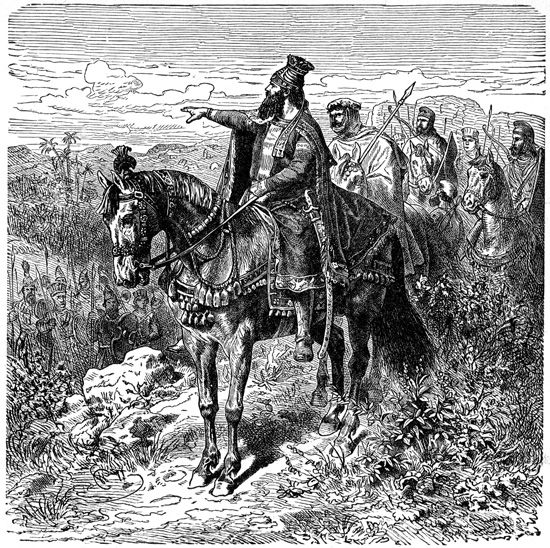
Cyrus II, also called Cyrus the Great, was the founder of the Persian Empire (539–331 b.c.e.). Born in about 600 b.c.e. Cyrus II was son of Cambyses I, grandson of Cyrus I, and great-grandson of Achaemenes, from whom the rulers of the Persian Empire take the name Achaemenids, or Achaemeneans.

At the time of Cyrus’s accession in 559 b.c.e., Persia was only a small tribal state in a world ruled by the then-dominant powers of Media, Lydia, Chaldea, and Egypt. Of these the Medes were, like the Persians, of Iranian blood and language lineage and had entered the high Iranian plateau some 1,000 or more years earlier.

In the first half of the sixth century b.c.e. the Persian tribes were vassals of the Medes, and Cyrus was the son from the marriage of his Persian father with the daughter of the Median king, Astyages. When Cyrus ascended the throne, his grandfather Astyages was still king of Media.


In 550 b.c.e. Astyages, concerned that his grandson was plotting with his enemy Nabonidus of Babylon, summoned Cyrus to his capital, Ecbatana, for an explanation. Cyrus refused to come, and this led to war between Media and Persia that ended with victory for the Persians and Cyrus’s becoming king of both the Medes and the Persians.

With Media conquered, Cyrus began a 10-year campaign that would create the greatest empire the world had known. He first tackled Croesus, the fabulously wealthy king of Lydia, and in 547 b.c.e. defeated him at the Battle of Ptyerum.

With Lydia conquered, he quickly defeated the Greek city-states of Ionia, and the whole of Asia Minor came under his rule. He now turned his view east and conquered Parthia and Aria in eastern Iran, the Sogdians and Bactria in Turkistan and Afghanistan, and even the western edges of India.

The Persian Empire stretched 3,000 miles from east to west but did not yet include the culturally and materially rich areas of Babylonia and Egypt. Egypt was left for his son to conquer, but Babylon was ready for a new ruler, and already those who wanted to see Persian rule in Babylon were growing in numbers.

In part this was due to dissatisfaction with the kings who presided at the time, Nabonidus, who had been absent from Babylon for 10 years, and his regent son Belshazzar, referred to in the book of Daniel in the Bible.

Equally important was the enlightened way in which Cyrus treated the states he conquered. Unlike the conquering Babylonian kings, and before them the Assyrian kings, Cyrus went out of his way to win the goodwill of his new subjects rather than to frighten them into obedience.

He presented himself as a liberator, treating prisoners with mercy, leaving local customs intact, and encouraging established religions. Cyrus attacked Babylonia in the autumn of 539 b.c.e. Belshazzar deployed his troops along the Tigris but was numerically overwhelmed even before Gubaru, the governor of the Babylonian province of Gutium, defected to the Persians.

After a campaign that lasted less than a month, Cyrus entered Babylon on October 12 without battle. From that day onward he treated the inhabitants with utmost respect, ensuring that society quickly went back to normal life and that the gods that had been taken into the city for safekeeping during the conquest were returned to their shrines in the cities of Babylonia.

Cyrus recorded his conquests and the way he treated the people of defeated cities in cuneiform script on clay or stone cylinders. These could be rolled over wet clay to create imprints, which when dried were sent out as letters or decrees. One such cylinder, today kept in the British Museum in London, gives us a glimpse into Cyrus’s empire.

It reads: “I am Cyrus, king of the world, great king, legitimate king, king of Babylon, king of Sumer and Akkad, king of the four rims of the earth, son of Cambyses, great king, king of Anšan, grandson of Cyrus, great king, king of Anšan, descendant of Teispes, great king, king of Anšan, of a family which always exercised kingship, whose rule Bêl and Nabû (the gods) love, whom they want as king to please their hearts.”

Later, on the same cylinder, Cyrus proclaims the freedom he is offering to captives. Some of those captives are the Jews who had been taken captive by the Babylonians in 587 b.c.e. and earlier in 597 b.c.e. by Nebuchadnezzar II.

In the biblical book of Ezra we read that in Cyrus’s first year of rule in Babylon he proclaimed to the Jews that they were to “go and build a house for God in Jerusalem,” and to facilitate this he returned to them the gold and silver that Nebuchadnezzar had taken from the Jerusalem temple.

After his successful conquest Cyrus remained in Babylon about a year and then moved back to the high plateau city of Ecbatana, the ancient capital of Media. However, we have almost no record of Cyrus’s actions between then and his death. In 530 b.c.e. Cyrus left his son Cambyses as regent in Babylon and personally set off to deal with a problem on his far northeastern border.

The campaign started well, but Cyrus was lured deep into the enemy territory and was there fatally wounded. His body was recovered by Cambyses II, and placed in a tomb at the Persian capital, Pasargadae, 50 miles north of Shiraz in modern-day Iran, where it can still be seen today.

Coptic Christian Church

Coptic Christian Church

The Coptic period covers most of the first six centuries of the Common Era. Copt derives from the Greek word Aegyptus, in turn derived from Hikaptah, or Memphis, the original Egyptian capital. Coptic Christianity is the form that arose in Egypt in the first century c.e.

By tradition Coptic Christianity began when St. Mark, the African-born gospel writer, went to Alexandria, Egypt, sometime between 48 and 61 c.e. Previously, Egyptian Christians were mostly Alexandrian Jews, and some Greeks became Christian.

Between his arrival and his martyrdom in 68 c.e., Mark founded the church and converted many native Egyptians. The religion grew rapidly in its first half-century, and by the second century it spread into the rural areas. Scriptures were translated into Coptic, the local language.


The rapid conversion of Egyptians to Christianity led to Roman persecution of those who denied the emperor’s divinity. An edict of 202 prohibited conversion to Christianity. An edict of 250 required all citizens to carry a certificate at all times, issued by local authorities, affirming that the bearer had sacrificed to the gods.

Failure to comply resulted in punishments, including beheading, being tossed to the lions, or being burned alive. The government closed the Catechetical School of Alexandria, forcing members to meet secretly elsewhere. The state limited the number of bishops to three. The era of persecution culminated under Diocletian (284–305). His election as emperor began the Coptic Anno Martyrum, year of the martyrs.

Despite the persecution, the church flourished. The third century saw the formation of the church hierarchy, from the patriarch in Alexandria to the lowest priest and the monks residing in the eastern and western deserts. The Catechetical School succeeded Alexandria’s library and museum, which were world renowned even before Christianity. Located in the School of Alexandria, the library held millions of papyrus scrolls, all the knowledge of the ancient world.

Ptolemy Soter established the library in 323 b.c.e. The school was the site where 70 Jewish scholars created the Septuagint when they translated the Old Testament from Hebrew into Greek in 270 b.c.e. These same scholars set the order of books in the Old Testament, including the Apocrypha. Beginning as a scientific and literary institution, the library evolved into a university for philosophy and theology.

The Catechetical School of Alexandria was the earliest major Christian theological school. The Catechetical School housed and taught the scholars who provided the philosophical underpinnings of Christianity. The school’s first dean, Pantaenus (d. 190 c.e.), headed a school whose faculty included Athenagoras, Clement, Didymus, and Origen.

Pantaenus was replaced by Clement of Alexandria, noted for his work in converting educated Greeks to Christianity. Origen (c. 215) was a philosopher and biblical scholar who wrote more than 6,000 commentaries on Old and New Testament books as well as homilies that are the oldest known Christian preaching. He is known as the father of theology.

Following Origen was Dionysius (the Great) of Alexandria, who became patriarch of the church (246–264). Didymus the Blind lost sight at age four but mastered grammar, rhetoric, philosophy, music, poetry, mathematics, and memorized the testaments. His pupils included Gregory Nazianzus, Jerome, Palladius, and Rufinus the historian.

Didymus devised a system of engraved writing, 1,500 years before the creation of Braille. These scholars made the Catechetical School a center of Christian learning and a magnet for scholars from around the world. The Catechetical School was the birthplace of the question-and-answer method of commentary.

While enduring Diocletian’s persecutions, the Coptic Church had to deal with the Arian heresy, which denied the divinity of Jesus because man had a beginning and God is eternal. Although Arius was excommunicated, he continued to preach and converted two Libyan bishops and the Nicomedian Eusebius.

Arianism spread through Egypt, Libya, Palestine, and Asia Minor before finally reaching the attention of Constantine the Great. Followers of Arius and Constantine fought in Alexandria and Nicomedia, leading the emperor to call the approximately 1,800 bishops to Nicaea to settle the dispute.

The Council of Nicaea (325), the first ecclesiastical council sanctioned by the emperor, included only six Western bishops because the heresy had not reached Europe. It involved more than 300 bishops from the East, representing all Christian traditions. At Nicaea, Arius chanted his beliefs, supported by dance bands and singers. Athanasius, representing the Coptic patriarch, presented a logical argument in opposition.

The attendees debated before calling for a creed, which Athanasius wrote and the Council of Constantinople (381) adopted unanimously. The Copts and other Oriental Orthodox Churches deny that they are Monophysites because Monophysitism is heresy. Copts believe that Christ is both human and divine, united indivisibly by the Word and perfect in all respects.

There were two patriarchs at that time, the Eastern Orthodox pope and patriarch of Alexandria and the Coptic pope and patriarch of Alexandria. Egyptian Coptic religion gave rise to the Christian monastic movement.

Monastics believe in unceasing prayer, intense meditation, self-discipline through fasting, vigils, celibacy, poverty, and the renunciation of the flesh and the world. It began as early as the second half of the third century, spreading throughout the Christian world. Monasticism flourished even after the Edict of Milan (313) ended the Roman persecution of Christians.

Coptic monasticism has three levels. First, Antonian monasticism entails a life of seclusion, austerity, and asceticism. St. Anthony exemplifies this approach. When an anchorite attains a higher level of holiness, he attracts many disciples in the second stage, and security becomes a concern.

Settlements arose in the eastern and western deserts, and communal living became the norm for monks who spent the week alone in their cells or caves and joined together on Saturday and Sunday for prayers, teaching, and service. Cenobitism, or Pachomian koinonia, was the third stage of monasticism. Founded by Pachomius, a former soldier, this form included strict military discipline, regulating every hour of every day and imposing punishment for default.

At the end of the fourth century Egypt’s deserts housed between 100,000 and 200,000 monks. The total Egyptian population was about 7.5 million. Cenobite monasticism attracted Greeks, Romans, Nubians, Libyans, Ethiopians, Cappadocians, and others. Each monastery had a section for each nationality and provided a fellow citizen to guide the monks.

Prominent Christians who went to the deserts included John Chrysostom, bishop of Constantinople; the Italian Jerome and Rufinus; Cappadocian father Basil the Great, who organized the monastic movement in Asia Minor; the French saint John Cassian, and Benedict who followed the Pachomian model in the sixth century, but made it stricter.

Coptic Christianity was devoted to missionary work from the time of St. Mark. In exile, in the armies of Rome, as travelers, Copts spoke and lived their faith, drawing converts as well as persecution. Coptic missionaries were in the British Isles long before the arrival of Augustine of Canterbury in 597. Some credit the Copts with bringing Christianity to the Irish (Irish Christianity was a great civilizing agent in the Middle Ages).

Coptic missionaries preached in Africa, Arabia, Persia, India, and Europe. Nubia became Christian in 559. Coptic Christians Frumentius and Aedesius converted Ethiopia. Alexandria by the fourth century was the largest Christian city in the world.

Monasticism attracted the pious but also attracted misfits and scoundrels, as well as young peasants, illiterate and easily formed into monastic mobs that could be used against heretics and political rivals in the church. Monks also served in the city’s hospitals.

Those who came to study at Alexandria returned to their lands full of Coptic knowledge and the urge to spread it by writing, establishing monasteries and schools, and otherwise proselytizing. According to the Melkite patriarchs, who served as both civil and religious rulers of the Eastern Roman Empire, Egyptian Copts were heretics because they rejected the agreement of Chalcedon.

Despite massacre, torture, and persecution by both religious and civil authorities, the Copts outlasted the state church persecution. Finally, in 642 Arabs conquered Egypt. Under Arab rule, the capital of Egypt relocated to Cairo. Coptic Christians continued to practice their religion.

Periodic persecution, particularly during the 10th and 11th centuries, and the European Crusades accelerated a gradual process of conversions to Islam, and by the end of the 12th century Egypt was predominantly Muslim. In the 20th century Coptic religion was strong, with 40 million adherents worldwide.

Damascus and Aleppo

Citadel of Aleppo
Citadel of Aleppo

Damascus and Aleppo were two cities situated at the center of the Silk Road, a key intercontinental trade route that linked the Roman Empire to China. Caravans traveling on the Silk Road traded in silk, perfumes, and spices in the Far East.

The city of Aleppo, for example, lay at the crossroads of two trade routes, one from India and the other from Damascus. They were important trading centers of caravan traffic and powerful centers of urban culture. Both regions are situated near the Mediterranean coast (about 62 miles from the sea).

The two towns contain agricultural land and nomad territory. Both Damascus and Aleppo suffered earthquakes, epidemics, and internal strife throughout history but were able to regain their prominence successfully after every adversity.


Damascus (Dimashq as-Sham in Arabic) is one of the oldest cities in the world that is still inhabited. The ancient city of Damascus lies within city walls. Excavations reveal that the earliest inhabitants lived there sometime between 10,000 and 8000 b.c.e. The city of Aleppo, on the other hand, was inhabited from 1800 b.c.e., according to archaeological records. After 800 b.c.e. the Assyrians, the Persians, and then the Greeks, in 333 b.c.e., ruled Aleppo.

Damascus only achieved prominence in 1100 b.c.e. after the coming of the Semitic peoples known as the Aramaeans. The Aramaeans built up the infrastructure in the city in the form of canals and tunnels linked to the Barada River. The water distribution system was then improved upon by later rulers of the city, the Romans who conquered Syria in 64 b.c.e., and members of the Omayyad dynasty.

Because of their similarities, Damascus and Aleppo were rivals, and comparisons were often made of them. Even though Aleppo was more successful in economic terms, it seems that Damascus thrived even more as a center of Islam. Islamic intellects often congregated in Damascus, and Islamic art flourished in the city.

Conditions in Damascus were very well suited for the flourishing of the intellectual and artistic milieu, as it had been the center of large empires of those who ruled over it. Damascus was after all the base for the Muslims against the crusaders in the seventh century c.e. During that time it was the center of administration of the caliph.

Damascus became the military and political base of Muslim fighters against the crusaders. Nuraddin first acquired Damascus and Aleppo in 1154, followed by Saladin after his death. In 1260 Mongols attacked the cities, which fell to the hands of the Mamluks in 1317. Damascus continued to enjoy political prominence under the Mamluks as the capital of the Mamluk Empire until 1516, though this period witnessed another Mongol invasion of Damascus in 1400.

Damascus occupies an important position in Sunni tradition as one of the holiest Muslim cities along with Mecca, Medina, and Jerusalem, because landmarks events in Islamic history occurred there. It is the birthplace of Abraham and is also where Moses was buried.

Daoism (Taoism)


The period roughly between 600 and 300 b.c.e. in China is called the era of the Hundred Schools of Philosophy, the term hundred meaning “many.”

It was an age of political and social change and turmoil as the Zhou (Chou) dynasty was breaking down, which led thinking men to develop philosophies to explain, accommodate to, or change the state of affairs.

Two out of these philosophies, Daoism and Confucianism, would endure as dominant and complementary ways of life for the Chinese for more than two millennia.


While all schools of philosophy were seeking the way, or dao, one among them would appropriate the
word for its teachings. While Confucians sought to return society to the golden age of antiquity through moral reform and study, others sought escape to a simple life, living as recluses and being content with nonaction; their philosophy is called Daoism.

It is difficult to find reliable information about early Daoism. However, scholars accept two books as the earliest works on Daoism: the Laozi or the Daodejing (Tao-te Ching), which translates as the “Canon of the Way and Virtue,” and the Zhuangzi.

The Laozi’s purported author was a man called Laozi, which means the Old Master; he supposedly was a senior contemporary of Confucius and had worked as archivist at the royal court. There is no proof that Laozi existed, and the short, cryptic book of about 5,000 words attributed to him seems to be a composite work that is no older than the fourth century b.c.e.

It teaches that the mystic Dao is the source of all being, which must be intuitively understood by leading a passively yielding life. It is a terse and enigmatic work susceptible to many interpretations. Its political philosophy teaches the sage ruler not to interfere in the lives of the people, give up warfare and luxuries, and passively guide the people to lives of innocence and harmony with the Dao. Modern laissez-faire ideals find similarities with Daoism.

Zhuangzi, which means Master Zhuang, lived around 369–286 b.c.e. Very little is known about him, and the book that bears his name is witty, full of paradoxes and imagery. The message of the book is a plea for the freedom of the individual and his liberation from egotism so that he can come to understand the underlying unity of the Dao and thus achieve happiness that is beyond death.

Even though Daoists taught nonaction and passivity, they were nevertheless human enough to preach their view in competition with other philosophical views. One can hardly imagine a country governed by the laissez-faire Daoist philosophy.

Nevertheless, when Confucianism became China’s official philosophy after c. 100 b.c.e., Daoism continued to hold its attraction because of its imaginativeness and perhaps as an antidote to the serious-minded ideals taught by Confucius.

Daoist philosophy has been a leavening agent in Chinese life, a consolation for those who suffered failures and a relief to the many duties that circumscribed life. In this way Confucian and Daoist philosophies supplemented and complemented each other.

Neo-Daoism is a movement that began in the Eastern Han dynasty (25–220 c.e.). One part of this movement undertook to harmonize Daoist teachings with Confucian social and moral ideals that made it possible for a Confucian official to be both a conscientious public servant and at the same to maintain a degree of detachment from the world.

The Daoist notion that rulers should rule passively and follow the advice of ministers appealed to Confucian officials. It became widely accepted practice during the Han dynasty that ministers should initiate policy and that emperors should not act before seeking the advice of his ministers.

When China fell to disunity for four centuries after the fall of the Han dynasty in 220 c.e., northern China came under the rule of non-Chinese nomads who had little understanding or use for Confucian doctrines. In this prevailing atmosphere two new movements took root. One was the popularization of Buddhism, introduced to China during the Han dynasty, at the beginning of the Common Era.

Buddhism did not gain widespread popularity under the Han, but its doctrines became widely appealing during the era of division. Similarly the intellectual energies that were absorbed by Confucian studies during the Han dynasties found outlet in the writing of commentaries on the Laozi and Zhuangzi during the era of division when Confucianism fell largely out of favor.

The study developed into a many-sided movement that investigated metaphysics, aesthetics, and religion. In the process these Daoist scholars also reinterpreted their philosophy in terms of the social and moral philosophy of Confucianism.

Some Neo-Daoists reacted to the disorder of the post-Han period by becoming hedonists and rejecting all social obligations and restraints. Their most famous example was a group during the third century c.e. that called themselves the Seven Sages of the Bamboo Grove, who explained their flouting of all social conventions as the only way of preserving their moral integrity.

One of these seven famously had a servant follow him with a jug of wine and a shovel wherever he went so that he could have a drink whenever he felt thirsty and so that a hole could be dug to bury him wherever he dropped dead.

They have been called romantic for their antics and their revolt against a decadent society. Other romantic Daoists who lived as recluses in mountain retreats have used nature’s inspiration to create landscape paintings that became the most respected genre of Chinese art and to write nature-inspired poetry.

Religious Daoism is also called popular Daoism. It is also called the School of Huang-Lao, after Huangdi (Huang-ti) the Yellow Emperor (the legendary founder of the Chinese nation) and Laozi. Whereas the Laozi and the Zhuangzi taught some adherents to live simply and in tranquillity, and others to reject the trammels of conventional behavior, another movement led by followers of the occult was also under way.

The result was the coalescing of many ancient folk superstitions and cults. Their goals were a long life, terrestrial immortality, and ultimately celestial immortality, reached through divination and magic, breathing and other yoga-like exercises, and living a moral life.

Daoist sorcerers and shamans used the Laozi and Zhuangzi as texts, searching for occult meaning in vague and suggestive phrases. They also consulted the Yi Jing (I Ching), or Book of Changes, an ancient text that began as a diviner’s handbook and had acquired obscure commentaries for their guidance.

Alchemy involved the search of substances and concoction of drugs that could improve health and prolong life, and also the turning of base materials into gold. Daoist experiments resulted in advances in chemistry, mineralogy, and pharmaceuticals and resulted in the invention of the compass, gunpowder, and porcelain. However, the questionable motives of the experiments made them less than reputable academically.

There were many subgroups among religious Daoists. One cult was called the Way of Five Bushels of Rice because its founder, a man called Zhang Ling (Chang Ling), who lived in the second century c.e., demanded five bushels of rice from his followers. They called him Heavenly Teacher, and he passed his title to his descendants to modern times.

The merit system taught adherents to think good thoughts and perform good deeds in order to prolong life and attain immortality and explained illness, death, and misfortune as punishments for ones’ own sins and those of one’s forebears; heaven or hell were everyone’s ultimate destination.

Popular Daoism learned from Buddhism in building temples, rituals, festivals, and instituting orders of monks and nuns. It has a large pantheon consisting of deities, historical heroes, immortals, spirits, and sacred spots. It enjoyed imperial patronage beginning in the Han dynasty, as rulers sought long life, immortality, and communion with the spirits.

Tang (T’ang) dynasty rulers also patronized religious Daoists, even as many were devout Buddhists, because the imperial house was surnamed Li and Daoists had long since given Laozi a surname, also Li, thus giving the ruling house an illustrious ancestor. The same elements that made religious Daoism favored by rulers also made it popular with the people of China.

Darius I

King Darius I and Persepolis

Darius I, or Darius the Great, consolidated the Persian Empire founded by Cyrus II. We know more about Darius than any other of the kings of the Persian Empire since we have two major literary sources on his life. The first is an inscription at Behistun in modern-day Iran that Darius had carved into a mountain rock face high up above one of the key trade routes from Mesopotamia to the Iranian high plateau.

It describes how in the early years of Darius’s reign he reestablished the empire after the rebellions following the death of Cambyses II. The second source is the Histories of Herodotus of Halicarnassus (c. 480 – c. 429 b.c.e.), a Greek who wrote describing the expansion of the Persian Empire from Cyrus to Xerxes I.

Darius was born about 550 b.c.e., son of Hystaspes, who was later the satrap of Parthia. Our first reference to Darius is as an officer in Cambyses II’s Egyptian army of occupation. On Cambyses’ death early in 522 b.c.e. Darius went straight to Media to press his claim to the throne through a common great-great-grandfather with Cambyses, Achaemenes.


In the fall of 522 b.c.e. Darius, with six coconspirators, killed the usurper claimant Gaumata, and to consolidate his claim soon thereafter married two of Cyrus’s daughters, and one of his grand-daughters, in addition to taking three other wives.

However, Darius’s claim was not easily accepted, and there was unrest throughout the empire. In the Behistun inscription Darius speaks of rebellions in more than half of the satrapies of the empire, including in the greatest city of the day—Babylon.

Unlike Cyrus who was welcomed almost as the savior of Babylon, Darius was looked on differently and only subdued Babylon after a siege and punishment by execution of 3,000 of the surviving leading citizens.

Relief of Darius I in Persepolis

Even then a second rebellion took place in Babylon some years later. It took until December 521 b.c.e. for all of the rebellions in other parts of the empire to be stamped out, and another few years before the empire was totally at peace.

Although Darius was successful militarily, his greatest achievement was the creation of an effective administration for the empire. According to Herodotus, as soon as peace was established Darius set up 20 satrapies, or administrative districts.

In each of the satrapies he established tax systems and recruitment requirements for his armies. He also built systems of royal roads and set up along them places where a change of horses, food, and lodging could be found for those moving about the empire.


With such a far-flung empire the satraps in charge of each satrapy had to operate with a significant degree of independence from the central government. However, that independence had the potential to threaten the emperor’s control, and Darius set up a system of inspectors known as the “king’s eyes” whose job it was to check on the effectiveness and loyalty of the satraps.

The improved road system and the construction of massive military granaries allowed for a large army and for the army to move about the empire with relative ease. In addition, Darius built a canal, completed in 498 b.c.e., connecting the Nile with the Red Sea, and thereby the Persian Gulf, which allowed trade by ship to go on across the width of the empire.

The building of roads also benefited trade and building projects in that materials could be more easily brought from distant parts of the empire to the place of construction. Palace cities were built in Susa and at Persepolis, the new Persian capital, and the construction of both probably benefited from the increased access to materials from other parts of the empire.

Even today the ruins of Persepolis suggest something of its former glory as the ceremonial capital of the empire. Each spring the most important of the rites, the New Year Ceremony, was enacted in Persepolis, and annual tribute was received from ambassadors representing every part of the empire.

Darius followed Cyrus’s example with a religious policy tolerant of a wide variety of gods. By way of example, in September 518 b.c.e. Darius visited Egypt, and Egyptian inscriptions record how he gave precious gifts to the key temples and paid homage to many of the most important gods.

Similarly, we have evidence of his offering sacrifices to Babylonian and Elamite gods and to the Greek god Apollo, who, as a god of wisdom, was taken as the Greek counterpart of the Persian high god Ahuramazda. His religious policy is also illustrated by the case of the Jews who had been promised funds by Cyrus to rebuild the Temple in Jerusalem.

Opposition by the Samaritans had prevented this, and the Bible records how the Jews petitioned Darius to look through the palace archives to find Cyrus’s original decree and thereby to prove the legitimacy of their project. Darius found the decree and gave his permission for the reconstruction of the Jerusalem temple, which began in 515 b.c.e.

In 499 b.c.e. the Greek cities in Asia Minor rebelled, and it took five years for the Persians to regain control of the region. In 490 b.c.e. Darius sent out another expedition, this time against the European part of the Greek-speaking world.

The Persians captured a number of Greek islands and then landed at Marathon, some miles from Athens. The famous Battle of Marathon, though paraded by the Greeks as their victory, was not a full one since from that time on the Persians controlled the Aegean Sea and set this as their western most boundary.

In November 486 b.c.e. Darius died at the age of 64. Starting with a loose collection of provinces, he had created a strong and well-organized empire to hand on to his successor Xerxes, the eldest son of his first wife.