David

The life of David, king of Israel, is full of paradoxes. He was called in the earliest historical traditions of the Bible, "the sweet psalmist of Israel" and the one chosen "after [God’s] own heart", yet he is famously summed up elsewhere as the adulterer and murderer "in the matter of Uriah the Hittite".

He was at pains to proclaim his loyalty to the previous and first king of Israel, Saul, and yet he was the ringleader of an insurrectionist group that undermined the government of that same king.

He was the boyish, sensitive son of a rural farmer, and he was the warrior who felled the champion of Israel’s nemesis and went on to slaughter "his ten thousands". It is in the juxtaposition of these images of David that later Jewish and Christian religious traditions find so much contradiction.

In historical terms David anchors the Bible in time and space. The theory is that the empire of David really did outshine the other ancient empires of its days, and this historical fact can be demonstrated. Before the narrative of David, the Bible shows the power of stories and myths to persuade and inspire people of later generations, but with David (and his son Solomon) comes external evidence to support biblical reputations and stories.


On the other hand, the evidence for the empire of David as described in the Bible is meager. It causes some modern scholars to hold that the idea of a united kingdom of Israel and Judah, founded by David and expanded by Solomon, is exaggerated or idealized. In fact, there is no mention of David in extant contemporary writings, yet there are inscriptions that mention his name within 200 years of his purported life.

According to the accounts found in various books of the Bible, David was anointed as king by one of the prophets and Judges, Samuel, who had rejected King Saul. David was the youngest in his family, a mere shepherd, but David was later chosen as a minstrel for the court of King Saul.

David’s humble beginning and inauspicious debut before Saul were even more incongruous with his next role as warrior and national savior. He wandered out to a battlefield and was provoked into a duel by the threats of the Philistine champion and giant Goliath. Once David slew the adversary, Saul’s army prevailed.

Back in the court, Saul grew ever more jealous of David. David’s charisma grew by the day, and by his exploits he persuaded even Saul’s son and daughter to protect his life. Saul’s jealousy reached the point of conspiracy against his otherwise faithful subject, so David fled into the wilderness for the life of an outlaw.

David was on the run constantly. His pursuers cornered him at least three times, but each time he miraculously escaped. He showed magnanimity when he rejected easy opportunities to slay King Saul.

Eventually he accepted his lot as an outlaw and recruited a band of other fugitives who took up banditry with him in the Judaean hills. In fact, the Bible portrays him as a kind of Robin Hood who protects his own kinfolk and their livestock, while he harasses those foreign armies who trespass Israel’s lands.

The next move took him to the land of Israel’s enemies, the Philistines. Here he took up with a local king who provided him safe haven for his looting and marauding in the area. In return, David committed his band of outlaws to help the Philistines.

When his services brought him to fight against his own king and countrymen, the other local Philistine kings refused to accept him. Thus, he was spared the dilemma of killing his own people or killing his foreign hosts. The result of the battle was that Saul took his own life when his army lost.

David became king of Judah, his home area, but it was several more years of fighting until he can become king of the northern kingdom of Israel. His first base was Hebron, a symbolic place where the Patriarchs’ tombs are located.

The war between Saul’s followers and David went on for another two to three years. With the death of Saul’s son and general, the northern region finally succumbed. In a brilliantly wise move David vacated his capital and conquered a city in a neighboring region, renaming this new location Jerusalem, or City of David (not the city favored by Judah or Israel).

From Jerusalem the expansion of the kingdom began. By the end of David’s life the empire extended from ancient Egypt to the Euphrates (present-day Iraq). He won systematic victories over every army that opposed him. If this description is accurate, it means that for the first time in history, Israel was truly a world power with which to be reckoned.

At the same time David showed his religious zeal when he brought the Ark of the Covenant into his capital. A temple was not built until the reign of his son Solomon. However, the Ark tied David to Moses and the covenant elaborated on Mount Sinai and as the most primitive symbol of worship connected David to the cult (temple, sacrifice, and priest).

In these otherwise halcyon years the cataclysmic lapse of David’s judgment occurred when he committed adultery with Bathsheba and then tried to cover it up by arranging for the death of her husband, Uriah. As the kingdom expanded, David’s house collapsed.

Within a few years the corruption of David’s house caused the unraveling of the kingdom: His daughter Tamar was raped, his son Absalom rebelled and was killed in battle, the northern part of his kingdom (Israel) attempted to secede under Sheba, and finally his two sons Adonijah and Solomon schemed and manipulated David for control of his kingdom.

Delphic Oracle

Delphic Oracle
Delphic Oracle

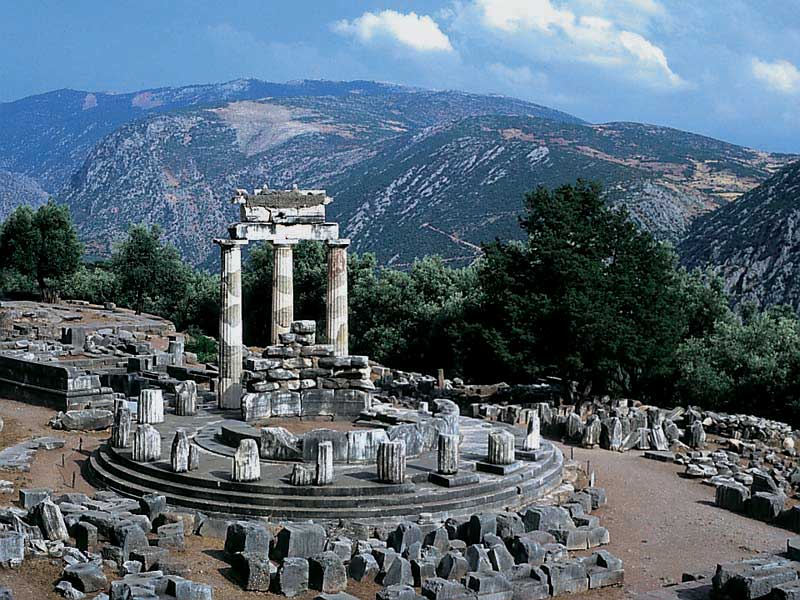
The Delphic oracle provided wisdom and advice to many ancient Greeks, and it continues to stir modern imagination regarding its verity and nature. According to archaeological evidence, the first temple of the site appeared in the eighth century b.c.e.

However, some have argued that its history is even longer and that it may have existed in a different location at an earlier date. Its origins are shrouded in myth, as the sources regarding the Delphic oracle are scarce and are largely of a literary variety.

The earliest written account with respect to the Delphic oracle’s emergence says that Apollo had come to Delphi—an area originally known as Pytho that had belonged to the earth goddess Gaia—and upon his arrival he killed the great python-dragon. Having destroyed the site’s guardian, Apollo established the location as a sanctuary, which was later to bear his temple. Inside the walls of the sacred house resided a human priestess, or Pythia, through whom Apollo spoke.


The Greeks believed that the temple’s location was the center of the universe. Set beneath the “shining rocks” of Mount Parnassus it was consulted by many individuals who ranged in importance. Initially, it was strictly statesmen of great power and other political representatives who visited the oracle; however, later in the oracle’s history wise philosophers as well as common citizens sought knowledge and advice at Apollo’s sanctuary.

The remains of the final temple of this once greatly prestigious and respected oracle can still be visited; however, Apollo’s voice at Delphi grew silent during the fourth century b.c.e.

The role of religion and divination in the life and politics of the ancient Greeks is a complex and elaborate one. It was hardly separable from daily existence, and it is difficult to understand the politics of the time without acknowledging early Greek religiosity. In fact, the very notion of citizenship was often defined by way of religion and cult.

Citizens sought knowledge and advice at Apollo’s sanctuary

Moreover, some scholars have argued that the Delphic oracle, and other sources of divination, played an influential part during the period of Greek colonization. Colonies were typically established by an individual founder (oikistes), who would consult an oracle for endorsement for the excursion, the location, and the justification of his leadership.

By extension the Greek oracles helped with the emergence and maintenance of the various Greek city-states (poleis). The oracular tradition of consultation was particularly important during times of political instability, as the words of the Pythia were used as a tool to eliminate social disorder.

Although the oracle’s responses did not substitute for decision making, they served as a means by which consensus or justification for a particular opinion or resolution was established. Because it was located outside the walls of the specific city-states that consulted it, the oracle was deemed nonpartisan and could therefore be trusted. However, some sources discuss bribery and gift giving either as a means to influence the Pythia’s prophecies or as an attempt to discover what advice was given to an enemy.


A sort of informal type of diplomacy took place at Apollo’s sanctuary. The oracle only granted divination sessions once a month and for only nine months out of the year. As a result numerous state representatives would have gathered at the site simultaneously.

Some of the earliest regions to have sought its advice were Corinth, Chalkis, and Sparta. By the late seventh and early sixth centuries b.c.e. Athens was also consulting Apollo at Delphi. However, during the sixth and fifth centuries b.c.e. other popular oracles arose at Dodona, Didyma, and Ammon, giving rise to greater choice for divine consultation.

The rivalry between the various oracles was also representative of the hierarchy of gods and their respective popularity. Delphi, and by extension Apollo, remained a favorite of many Greeks for quite some time.

Oracle maquette
Oracle maquette

Only with the emergence of Alexander the Great, who initiated the imperial age and the collapse of the Greek poleis, did the oracle of Delphi begin to fall out of favor. The concurrent decline of the oracle and the city-states further provides evidence for their important reciprocal relationship.

There is still debate surrounding what exactly took place during a consultation at Delphi and in what manner the response of Apollo was delivered by the Pythia. Fantastical accounts claim that the Pythia mounted a tripod and after inhaling fumes that rose from a chasm in the earth, she was sent into a frenzy or trance and uttered unintelligible words.

The attendant priests translated the utterances and delivered a clarified version to the inquirer. However, a more rational portrayal in contrasting scholarship describes the Pythia filled with the divine breath (pneuma) or wisdom of the god, whereupon she replied with great clarity to questions asked both orally and in written form. One account of a former priest instead describes the Pythia as being peaceful and composed after the sessions.

A number of the recorded responses received at Delphi have been preserved, and modern scholars have divided them up into categories ranging from the historical to the fictional. Due to problems in translation and the vagary regarding the context within which many messages were delivered, some of the recorded prophecies are less plausible and even incoherent.

Given the nature of such pronouncements on behalf of a god, the authenticity of any of the claims cannot be completely verified. For the most part the responses followed a set of stages. The Pythia would begin by declaring that the message should be taken seriously, reminding those present that the source was Apollo himself.

Next, she would acknowledge the seeker on behalf of the god and express a degree of interest and concern. This would be followed by the Pythia’s answer. She would invariably conclude with a message that was intentionally challenging insofar as it demanded some further interpretation and thought.

Although some have alleged that the responses were entirely arbitrary and ambiguous, others have understood the complexity differently. The argument follows that the power of personal judgment and intuition were very important and necessary virtues in order to insight-fully comprehend the Pythia’s prophecies.

In fact, the often-quoted injunction “Know Thyself” was inscribed in the lintel over the temple’s entrance. Without a certain amount of personal knowledge, it would be difficult for an individual to interpret correctly advice or wisdom.

The ancient Greeks took the wisdom of Apollo and his priestesses seriously for many years and continued to return despite the fact that the responses were not delivered in a cut-and-dry fashion.

Although we are left with little more than hypotheses as to how exactly many of the prophesies were interpreted and what impact they might have truly had, there is little doubt that the mystery surrounding Delphi has remained enchanting for the modern mind as individuals today likewise strive for wisdom and truth.

Deuteronomy

Deuteronomy

The last book of the Pentateuch is the book of Deuteronomy. Its importance lies in the fact that it is often thought to present the theology that typifies and organizes the next group of biblical books, from Deuteronomy to 2 Kings.

This latter group of books in effect represents biblical history as seen from the perspective of the editor of Deuteronomy and is called Deuteronomic History (DH). Martin Noth first made the claim concerning this particular biblical perspective, but now it is the consensus of most scholars of Israelite history and religion.

Deuteronomy comes from the Greek term meaning the "second law". The law in this book then is a reformulation of the Torah law given to Moses on Mount Sinai, but it is not really the classic formulation of legal code. Rather, it is expressed as if it were a sermon or homily, not action-oriented but attitude-oriented.


Throughout the book of Deuteronomy are speeches and exhortations that stir up the reader to stay faithful to the Jewish law given to Moses, especially the law of monotheistic worship. The book consists of three speeches, plus some appended materials at the end, all purporting to be the last will and words of Moses given before entrance to the promised land of Canaan.

Some speculate that the first four chapters display an introduction to the whole DH, while the next few chapters provide an introduction to the book of Deuteronomy. The book, perhaps in its primitive form, was apparently lost for a while, but it was recovered by King Josiah of Judah in 621 b.c.e., who tried to bring about the sort of revival envisioned by the later writer(s) of the DH.

According to scholars, the DH starts with the material of Deuteronomy and crafts the subsequent narrative, speeches, annals, and records so that the reader never loses sight of the same lesson. They notice a repetition of language, style, and theme throughout the subsequent books of the Jewish scriptures until 2 Kings, and they believe that there is a deliberate purpose and editorial design that qualify all the books to be called the Deuteronomic History.

Basically the DH tends to take a pessimistic view of Israel’s history: Israel’s behavior is frequently unfaithful to its divine covenant as expressed in the laws of the Torah, especially in the area of idolatry.

If this hypothesis is accurate, DH probably qualifies as an early effort to produce a canon of the Bible. Throughout the book of Deuteronomy is the caution not to add to or take away from the written words, a natural injunction if the book is thought of as canonical.

Scholars differ as the date of Deuteronomy and DH, but most tend to read it as an edited collection written after Nebuchadnezzar II’s expulsion of the people of Israel in 587 b.c.e. David Noel Freedman sees Jeremiah’s scribe, Baruch, as the one responsible, but others simply find a perspective that represents the north (of the Israel and Judah divide) and the prophets found there.

This canon would stand in contrast to two other strands of the Bible discerned by scholars, namely, the Priestly books (largely the Torah) and the Chronicler books (the later histories of the Bible and the books of Ezra and Nehemiah). Because the DH is a rather late compilation, it would frequently represent in veiled ways the Babylonian captivity. In fact, there are passages in other books, not in the DH, which reflect the attitudes of the DH.

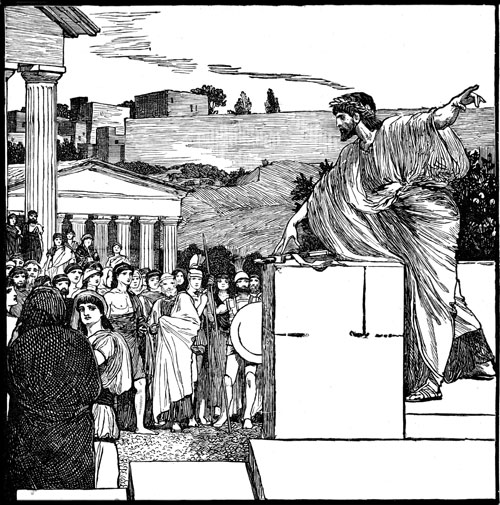
Demosthenes

Demosthenes
Demosthenes

Demosthenes was the most famous orator of ancient Athens and a principal voice in the attempt to maintain democracy in the face of the threat of the tyrannical Philip of Macedon and his son Alexander the Great. He is remembered largely because of the many speeches he left behind. Many details of the life and times of Demosthenes are recorded in Plutarch’s biography.

Demosthenes was the son of a sword maker of some substance, but after his father died, he passed into the care of a series of guardians who cheated him of most of his inheritance. His desire to sue one of his guardians inspired Demosthenes to take his first steps toward becoming a public speaker.

As a young man, he suffered from a frail physique and a weak, stammering voice. To overcome these problems he supposedly sucked pebbles in his mouth while using his voice to compete with the noise of the sea.


Demosthenes was highly renowned for his speechmaking, and his services were in great demand. He struggled to build his reputation and achieved it in part as a speechwriter for those filing lawsuits and spoke in public to plead their case.

By the age of 30 he had begun to make speeches to the full Athenian assembly (Ekklesia), most notably in connection with the need for Athens to build its naval defenses against a possible resumption of invasion attempts by the Persians. Demosthenes argued the importance of independence and the use of defensive alliances to deter attacks.

Demosthenes made his reputation with speeches that have become known as the Philippics, the orations against Philip of Macedon and the threat the Macedonians represented to Athenian democracy. These were made in the bear-pit atmosphere of the Ekklesia, which was notorious for the rough nature of debate and audience participation. His success led to him becoming one of the most important men in Athens.

His position was consistently in favor of independence, and he was frequently in conflict with interests that would have accepted infringement of civil liberties for the sake of economic development. When Philip’s army started to threaten Athens in earnest, the debate became ever more vociferous. Conflict was avoided primarily because Philip judged the time not yet ripe.

Peaceful relations became increasingly strained as the well-organized and -led Macedonian forces took over ever-greater parts of Greek territory. Ultimately, a pretext arose for Philip to bring the Greeks to battle at Chaeronea, and he delivered a crushing defeat on them. Plutarch claims Demosthenes dropped his arms and ran away from the battle.

Even so, Demosthenes was elected to give the funeral orations and continued to speak in the Ekklesia against Macedonia. When pro-Macedonian support waxed after the accession of Alexander, Aeschines took the opportunity to bring a case that he anticipated would destroy Demosthenes’ reputation.

However, in denying charges of corruption, cowardice, and wrong headedness in a speech known as "On the Crown", Demosthenes routed his opponent, who was subsequently forced to accept exile. This vindication of both his personal integrity and his policies lasted only a few more years.

In 324 b.c.e. Demosthenes was convicted of accepting a bribe and was fined and imprisoned. He subsequently escaped and was even invited back to Athens two years later. However, faced with the opposition of Aeschines, Demosthenes took poison and died. Demosthenes is best remembered for his oratory and some aspects of his political beliefs.

Desert Fathers and Mothers

Desert Fathers and Mothers
The designation “Desert Fathers and Mothers” refers to sources of ascetic literature from late antiquity that are associated with monasticism principally in the deserts of Egypt, Palestine, Syria, and Arabia.

Monasticism, which sought physical removal from the inhabited world, quickly identified with the uninhabited desert as a refuge from temptation and as a hostile environment in which to train the body and the mind toward the single goal of serving God.

The literature that captured the central ideas of those who had renounced and withdrawn from the world consists of practical advice for monks, primarily solitaries, including those who might not have access to an experienced teacher.

The essential example of this literature consists of the Apophthegmata Patrum, or The Sayings of the Desert Fathers. This collection circulated in the East and West in three different editions and was translated into a number of languages before the Middle Ages. One edition is attributed to Poemen of Egypt, as are several of the sayings in the collection.


It is possible that sayings attributed to Poemen by his disciples were the kernel around which the rest of the collection grew. Other Desert Fathers include Anthony, Pachomius, Ammun, and Bishoi, all of Egypt, and Hilarion and Abba Isaiah of Palestine.

Sarah and Syncletica are two of the names of several Desert Mothers whose sayings have been preserved. In the version of the Sayings that is arranged alphabetically by the name of the father or mother, there are some 134 names. Those fathers and mothers who can be dated are all from the third and fourth centuries c.e., and reflect preclassical Christian monasticism.

The literature consists of short and direct statements on different topics. Topics include vigilance, self-control, humility, fasting, and prayer. The role of the the spiritual father (abba) or mother (amma) was essential to the perspective of the Desert Fathers and Mothers. The abba or amma was not a discussion partner or counsel but a source of wisdom, whose advice the novice was to put into practice.

Rather than theological speculation, the abba’s or amma’s advice is the epitome of simplicity and common sense. This advice was always specific to the individual and, hence, was based on the abba’s or amma’s knowledge of his or her novice.

Each monk or nun must experience his or her own path of spiritual progress. The Desert Fathers and Mothers as the source of this wisdom were thus held not as strict models to be imitated but rather pioneers from whose mistakes and discoveries later generations could profit.

This literature was intended to complement the rule of a monastery and church legislation designed to ensure a stable institution, regulating the life of the monastic community so that each of its members could proceed on their individual Christ-centered spiritual path.

The practical approach to questions taken by these authorities was reflected in every aspect of the monk’s or nun’s work, the goal of which was to find God. The Desert Fathers and Mothers are presented as champions of asceticism.

Asceticism entailed fasting and the control of the passions as well as the struggle with demons both within and without, but the end of this work was to become humble, quiet, and vigilant in order to serve God and neighbor, to listen for and to the Word of God, and to trust in God alone.

Dharma Sutras

Dharma Sutras
Dharma Sutras
The Dharma Sutras are manuals on correct behavior inspired by the Vedas and which exist in a number of different formats and styles. Many of the numerous verses within the Dharma Sutras consider such topics as appropriate dietary behavior, the duties and rights of kings and rulers, and suitable forms of behavior for people of different ranks in various circumstances.

Some sutras were developed and codified into shastras, which are more established frameworks of rules that were used to create Hindu laws.

The principal Dharma Sutra is considered to be the Manu-smrti (The Laws of Manu), which was created around 200 c.e. (although probably begun earlier) and consists of 12 chapters with a total of 2,694 verses.

The contents range from practical prescriptions for funerary and dietary practices to legal systems and religious strictures. This sutra acted as the law that governed the societies of much of India for a number of centuries.


This led to the four-caste conception of society and the social structure that underlay the whole of Hindu society. The fundamental structure of society, therefore, has integrated within it the notions of hell, heaven, and the proper behavior of the individual as a member within a designated caste.

Another sutra of great influence and prestige was written by Yajnavalkya and has just over 1,000 verses arranged in areas relating to the law, expiation, and methods of good conduct.

This makes the canon rather lengthy in nature, and it contains disparate elements that would seem irrational from the Western point of view. However, the Hindu conception of the universe is able to reconcile these elements, so far as they are fully aware of them, into a coherent whole.

The Dharma Sutras are combined with the Srauta Sutras (dealing with sacrificial rituals) and the Grhya Sutras (dealing with domestic rituals) to make up the Kalpa Sutra, which is a manual of religious practice written in a short and aphoristic style that facilitates committing the material to memory.

Each school of the Vedas had its own Kalpa Sutra, and each Kalpa Sutra is one of the six vedangas, the canon of religious and philosophical literature, descended from the Vedas. They are created by humans and hence have the name smrti, or “tradition.”

Emperor Diocletian

Emperor Diocletian statue

The emperor Diocletian was born Diocles on the coast of the Roman province of Dalmatia, which lies on the western shore of the Balkans. Born in the early years of the "Military Anarchy", Diocles witnessed the collapse of the empire into a series of civil wars, leaving Rome splintered in the face of a continuous front of enemies. The emperors were continually on the defensive.

By the time of Valerian’s rise in 253 c.e., Germanic tribes overran the Rhine and Danube frontiers. The Sassanid Empire of Persia would take advantage of this situation by overrunning the Romans in Syria and retaking Antioch.

Valerian moved against the Persians and was able to retake Antioch, but in a terrible Roman defeat, Valerian’s army was surrounded at Edessa in 259. The emperor was led into Persian captivity.


Such political instability allowed a man like Diocles the opportunity to rise above the station of his birth. At a time when military powers were struggling for control of the fragile Roman Empire, the status of a soldier was enhanced. After 260, Gallenius had stripped senators of their right to command legions and the sons of senators of their rank of deputy tribune.

These positions were given to career soldiers, thus opening opportunities for advancement in the rank and file. Diocles was either a freed slave or the son of a freed slave, and his education was extremely limited. Diocles joined the imperial army before 270 and in less than two decades rose far.

In the 270s mention was made of Diocles being commander of a sizable military unit on the lower Danube, roughly modern-day Bulgaria. Descriptions vary, but they agree that Diocles lacked natural heroic bravado.

Rather, he set himself to military tasks with cautious and cool precision, showing himself to be a better leader than soldier. In 282 the legions of the upper Danube declared the Praetorian prefect Carus emperor, and before the emperor Probus could respond, his own soldiery killed Probus.

Diocletian palace
Diocletian palace

Diocles’ role in the coup is unclear, but under Carus’s short reign he rose to the highest levels of military leadership. Carus elevated Diocles to command of the protectores domestici, the elite force that accompanied the emperor into battle. This gave Diocles intimate access to Carus, and he was made a consul in 283.

Following Carus’s sudden death, his son, Numerian, was named emperor, and Numerian’s father-in-law and the prefect, Aper, began gathering military power. In 284 Numerian died, and Aper, who had charge over him, was arrested by soldiers on suspicion of plotting against the emperor.

The collected army leadership halted near Nicomedia, and in a ceremony the representatives of the military units elected Diocles emperor. Diocles’ first act was the execution of Aper for Numerian’s murder. He then took the name Gaius Aurelius Valerius Diocletianus.


Diocletian still needed to subdue Numerian’s brother, Carinus, who controlled the western provinces of Rome. Constantius, the governor of Dalmatia, supported Diocletian, and Carinus was weakened by the revolt of one of his military leaders, Sabinus Julianus.

When the battle between Carinus and Diocletian took place near Belgrade in 285, Diocletian was nearly defeated when his armies’ lines were broken. But Carinus’s forces did not take advantage of their battle gains and soon discovered that Carinus was dead. Tired of battle, the soldiers of Carinus’s armies swore allegiance to Diocletian, who became sole ruler—Augustus of Rome.

In order to overcome simultaneous military emergencies continuing to befall the Roman Empire, Diocletian adopted the younger general Maximian as heir and elevated him to the status of Caesar, a powerful and historic position inferior to the status of the Augustus.

While Maximian was ambitious and able, he was a soldier of little political imagination, making him the least likely of Diocletian’s supporters to attempt to seize power. Maximian, now legal son of Diocletian and a Caesar with armies, was charged with restoring Roman authority in Gaul and the West.

A revolt in Britain soon necessitated a more drastic measure. When Carausius, a general in Britain and Gaul, was declared Augustus by his armies and challenged the mere Caesar, Maximian, Diocletian boldly elevated his adopted son Maximian to the status of Augustus. Diocletian and Maximian, both soldiers commanding armies, held real power in their dual rule.

Under their leadership the question of dividing the empire into opposed states never arose, and this reform in government would play a central role in Rome’s recovery. The two emperors could now face their enemies simultaneously in the north and east and take advantage of the fact that the fronts were composed of small, independent armies.

Diocletian sought to establish his capital in Nicomedia. After the first five years of the dual rule, Diocletian set about to further cement the government and made reforms that would consolidate advances made to secure Rome after its long decline.

Diocletian first moved to establish the Tetrarchy in order to secure succession to the throne and maintain orderly dual rule. In the Tetrarchy each Augustus would adopt into his family a Caesar as junior partner. After a decade the two Augusti would retire in favor of the Caesars, who would in turn each adopt a Caesar.

Beyond the military and governance reforms of the establishment of the Tetrarchy, Diocletian reformed the military structure, establishing frontier forces that provided defense, with a mobile reserve force maintained more centrally.

When hot spots flared, the reserves could reinforce the frontier armies. The power of military leadership was divided in an attempt to reduce their threat to imperial authority.

Diocletian’s rebuilding projects and investments in infrastructure can be seen as part of a larger plan for economic reform. Availability of goods, such as food and materials, was improved when they could more easily be transported across the empire.

However, rampant inflation was hard to control, and Diocletian engaged in an attempt at price fixing. His Edict on Maximum Prices, while ultimately failing to control prices and inflation, was a serious attempt at controlling runaway inflation, with some offenses punishable by death.

Perhaps under the influence of Galerius, who was known to be opposed to Christianity, Diocletian’s rule continued Rome’s persecutions of the Christian religion. Begun in 303, this wave of persecution would cease only in 312. A series of edicts commanded that churches and scriptures be destroyed and that church leaders be imprisoned.

Many of Diocletian’s reforms, such as the Tetrarchy, did not long survive his retirement in 305. Upon his retirement, he became the first living emperor to leave office of his own accord. The Tetrarchy did manage to halt Rome’s slide into anarchy, and the rule of the Tetrarchs renewed Roman frontier defenses.