Druids and Picts

Druids

The Picts and the Druids were among the pre-Roman civilizations in the British Isles. There is little concrete information about either group, particularly prior to Roman contact. The Druids were the priests of many ancient Celtic societies, which included those in northwest Europe as well as the British Isles.

The Druids were preservers and enforcers of tradition among these tribes, passing on an oral literature that did not survive the arrival of Rome and the decline of the Celtic languages and cultures.

They were probably the most learned class among their people and may have passed on to the laity a good deal of practical knowledge in addition to the religious teachings of their polytheistic faith.


Our written sources about the Druids are exclusively Roman. Gaius Julius Caesar’s Gallic Wars ascribed to the Druids among the Gauls the authority to make judgments in disputes both civil and criminal and the use of exile as punishment. Other writers wrote of Druids telling fortunes, receiving instruction in secret, and overseeing sacrifices, including human sacrifices.

They were almost certainly the keepers and designers of the calendar the Celtic tribes followed. Though they have long been associated with Stonehenge in the popular imagination, Stonehenge predates the Druids considerably, and they could not have had anything to do with its construction.

It is primarily the result of historical fads in the 18th and 19th centuries that so many misconceptions about the Druids are lodged in popular thought, many of them the product of poor scholarship or outright fabrication. It is from that period that many “modern druidic movements” stem, some of them claiming an unbroken connection to the Druids of the Iron Age.

Little, too, is known about the Picts, who inhabited Pictland (northern Scotland) from antiquity until the Middle Ages. A loosely affiliated, ethnically similar group of tribes, they confederated into a number of kingdoms (sometimes ruled over by a high king to whom others owed fealty) sometime after the arrival of Romans in the British Isles.

Presumably, the Pictish religion, and perhaps its language, greatly resembled that of other Celtic groups before this time and converted in the fifth and sixth centuries.

Once Christianity was entrenched, the cult of saints was especially prominent in Pictland, with patron saints associated not just with towns and kings as in much of Christendom but with noble families. Kingship generally passed from brother to brother before passing on to a son, favoring experienced leaders over a direct line of succession.

The Picts are famous for their use of war paint and tattoos, and their name derives from the Latin word pingere, for “paint.” This may have been a myth, and it is unlikely they used woad (which takes poorly to skin) to dye themselves blue, as was once thought. The myth may have grown because of the fierceness of the pirates and raiders among the early Picts; such warriors tend to accumulate hearsay around them.

Duke of Zhou

Duke of Zhou

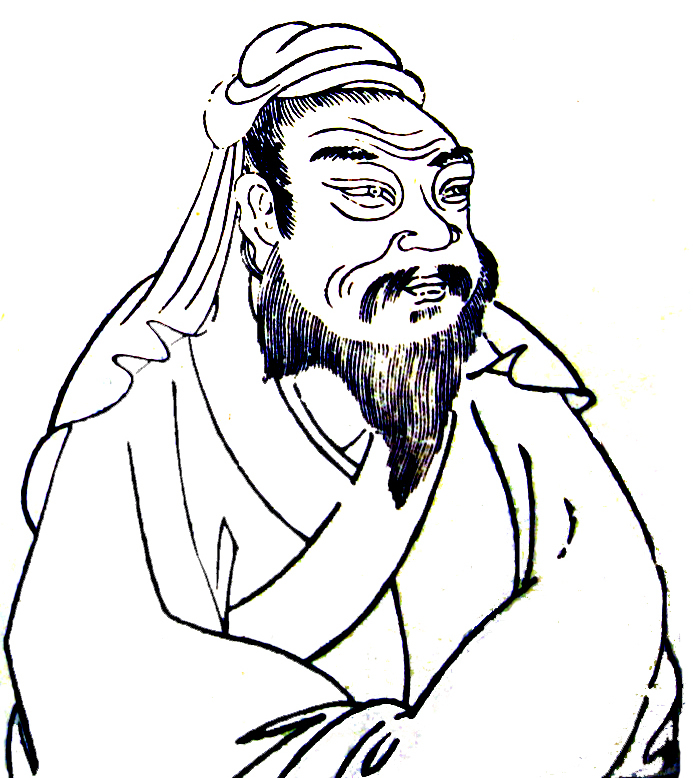
In Chinese tradition King Wen (the Accomplished), King Wu (the Martial), and the Duke of Zhou are revered as the wise founding fathers of the Zhou (Chou) dynasty (c. 1122–256 b.c.e.) and their era is considered a the golden age.

King Wen prepared the way; King Wu overthrew the Shang dynasty but died shortly after, leaving his young son King Cheng (Ch’eng) under the care of his uncle, the Duke of Zhou, as regent.

Soon after this event three other brothers of King Wu, who had been sent to govern the former Shang territories in the east, and the Shang prince who had been set up as nominal ruler of the Shang people, joined in rebellion. After two years of warfare the Duke of Zhou and his brother the Duke of Shao defeated the rebels.


The Shang prince was killed, the Shang capital, Yin, was leveled, and another Shang prince was set up to rule another fief called Song (Sung) further east. The rebel Zhou princes were either killed or exiled. Thus ended the first crisis of the new dynasty.

The Duke of Zhou then pressed further east and brought all peoples to the coast under Zhou rule. The Zhou territory was larger than that of modern France. To consolidate the conquests the duke sent loyal relatives to establish strongholds in strategic locations and set up a second capital at Luoyang (Loyang), strategically located at the junction of the Luo (Lo) and Yellow Rivers.

During the early Zhou era numerous walled cities were built, governed by relatives and supporters of the new dynasty, who gradually established control over the population.

Their territories were called guo (kuo). The king ruled directly over the largest territory in the center of the political order, called Zhungguo (Chung-kuo) or the “central state,” which came to mean “China” and known to the West as the Middle Kingdom.

The new rulers were given titles of rank, translated as duke (reserved for sons and brothers of the king), marquis, count, viscount, and baron. Together the nobles were referred to as “the various marquises.”

Most of the nobles were related to the royal house either by blood or by marriage; they looked to the king as head of their vast extended family and the Zhou clan as their common ancestors. Many common features between these Zhou institutions and European medieval feudal institutions have led historians to call the early Zhou polity feudal.

The Duke of Zhou is also credited with creating the well-field system that equitably distributed farmland to cultivators; eight families grouped together farmed plots for themselves and together farmed the ninth one for their lord.

The Duke of Zhou explained to the Shang people that the change of dynasties was the will of heaven, which punished the last Shang king for his wickedness and rewarded the house of Zhou for its virtue.

He also lectured his nephew that the concept of “Mandate of Heaven” was a double-edged sword and could be cut when the personal and political conduct of the new rulers did not measure up to heaven’s expectations. After a seven-year regency, and having accomplished his mission, he returned power to his nephew and retired to his own fief called Lu in eastern Shandong (Shantung).

Dunhuang

Dunhuang
Dunhuang

Dunhuang is located in present-day Gansu (Kansu) Province in northwestern China. It was strategically important to China and came under Chinese control under Emperor Wu around 120 b.c.e. during the Han dynasty. He stationed a garrison there to prevent two nomadic peoples, the Xiongnu (Hsiung-nu) and the Qiang (Chiang), from joining forces against the Chinese.

The Han dynasty’s military successes resulted in the Pax Sinica, in which China dominated the eastern part of the Eurasian continent at the same time that the Roman Empire dominated the western end (Pax Romana). Trade prospered between China with Central Asia, India, Persia, and the Roman Empire via the famous Silk Road.

The Silk Road’s eastern starting point was China’s capital, Chang’an (Ch’ang-an), and led across the Gansu Corridor to Dunhuang, the gateway city, after which it divided into a northern and southern branch across mountains and deserts until the two branches joined at Merv, then to the eastern shores of the Mediterranean.


Dunhuang’s position at the intersection between Chinese, Indian, and Central Asian cultures made it important in China’s political and cultural history. Dunhuang’s richly furnished Han-era tombs prove its prosperity. The census of 1–2 c.e. shows that there were 11,200 registered households in the commandery with almost 40,000 persons.

Merchants passed through Dunhuang with their wares, as did Buddhist missionaries and pilgrims en route to and from India and diplomats and armies from the courts of empires across Eurasia. Near to Dunhuang lies a mile-long strip of land intersected by a stream whose water made agriculture possible.

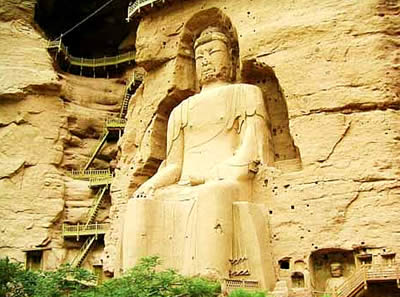
Lying to the west of the stream is Mount Mingsha, where for a thousand years men carved cave temples called the Caves of the Thousand Buddhas (also called the Magao Caves).

Introduced from India, cave art in China is synonymous with religious art, especially Buddhist art. From Dunhuang the practice of excavating Buddhist cave temples spread to Datong (Ta-tung) in Shanxi (Shansi) Province and Luoyang in Henan (Honan) Province, the sites of the Yungang (Yun-kang) and Longmen (Lung-men) caves.

But the Dunhuang caves stand out as the largest in size and of the longest in duration, spanning from around the beginning of the Common Era to the Yuan dynasty in the 13th century c.e.

They were built by generations of pious people and decorated with paintings and sculpture. The grottos were adorned with murals over plaster and painted clay sculptures.

Thousands of grottos were excavated, of which 492 remain; they show the evolution of Buddhist art style and the assimilation of styles from several cultures. Western explorers discovered the caves and a treasure trove of hidden ancient manuscripts at Dunhuang at the end of the 19th century.

Many of the manuscripts and art treasures of Dunhuang were moved to Western museums; others were preserved in China. Dunhuang studies have added to knowledge of Buddhism and Chinese history and culture.

Ebla

The ancient city of Ebla

The ancient city of Ebla is identified with modern Tell Mardikh in north Syria, 34 miles south of Aleppo. It created a sensation when archaeologists uncovered the largest single find of third-millennium cuneiform tablets there. The University of Rome has excavated the site since 1964, under the leadership of Paolo Matthiae.

Ebla is poorly attested in the Early Bronze I–II Periods (c. 3200–2700 b.c.e.), with an absence of Uruk pottery. This suggests that Ebla did not emerge directly due to the development of Sumerian colonies along Syrian trade routes, by which means the “Uruk culture” was disseminated.

By 2400 b.c.e. Ebla had grown into an urban center of more than 135 acres. A palace constructed on the acropolis (designated as “Royal Palace G” by archaeologists) testifies to the increasing importance of centralized administration.


Ebla’s urbanization may possibly be interpreted in terms of the sociopolitical climate prevalent in Syria at that time. With the Mesopotamian city-states extending their influence through long-distance trade, those in Syria felt the pressure to organize and assert their political independence.

Upon excavation Royal Palace G revealed a large archive of cuneiform texts, dated to 2400–2350 b.c.e. The texts span the reigns of Kings Igrish-Halam, Irkab-Damu, and Ishar-Damu, as well as the tenure of important court officials such as Ibrium, Ibbi-Zikir, and Dubukhu-Adda.

The archive contained a grand total of about 1,750 whole tablets and 4,900 tablet fragments. A severe fire, which destroyed the palace, had fortuitously baked and hardened the tablets, thus helping to preserve them.

Scholars generally agree that these cuneiform texts were intended to be read in the local language, Eblaite. However, the texts tend to be written with numerous Sumerian logograms (word signs). This means that Eblaite pronunciation and grammar are often not reflected in the writing.

Some have considered Eblaite to be northwest Semitic, possibly an antecedent for the later Canaanite dialects. Others have noted its affinities to east Semitic languages, such as Old Akkadian.

It is conceivable that Eblaite represents a time before the northwest and east branches of the Semitic family were clearly distinguished. Alternatively, Eblaite may represent the dialect of a geographical region that was influenced by much interaction with both East and West.

Among the tablets are lexical texts that list the Sumerian logograms followed by their Eblaite translations. These represent the earliest attested bilingual dictionaries. Other lexical texts list words according to various categories, such as human vocations, names of fishes, and names of birds.

The sequence and arrangement of these lists are identical with those in southern Mesopotamia, signifying Ebla’s indebtedness to the Sumerian scribal tradition.

Several texts mention, “Young scribes came up from Mari,” and may suggest a means by which Mesopotamian scribal practices passed into the Syrian regions. The Ebla scribes, nonetheless, preferred their own method of number notation and system of measures, instead of adopting Mesopotamian forms.

The vast majority of tablets consist of administrative and economic records, which elucidate much of Ebla’s society. The highest authority at Ebla was designated by the Sumerian title EN, which is translated in Eblaite as malikum (king).

The Sumerian title LUGAL was used in Ebla for governors, who were subordinate to the king. This contrasts with the usage in Mesopotamia, where LUGAL typically denotes an individual of higher rank than an EN.

Royal inscriptions, which laud the king’s power and legitimize his reign, have not yet been found at Ebla. Also, Ebla does not follow the usual Mesopotamian practice of naming years according to significant acts of the king.

Such reticence has encouraged the view that Ebla’s king did not rule as an absolute monarch but as one reliant on leading tribal elders for aspects of state administration. The cult of dead kings is attested at Ebla, with ritual texts describing various sacrifices offered to previous rulers of the dynasty.

Ebla was divided into eight administrative districts. The districts on the acropolis were named saza, while those in the countryside were named ebla. It was the palace, rather than the temple, that chiefly directed the city’s economics.

The palace was responsible for the ownership of land, the sustenance of Ebla’s workforce, and even the record of animals used in religious sacrifices.

In Ebla, however, the system of labor management was not as highly developed as that of Mesopotamia. Agriculture and industry often remained under the management of local communities, which in turn reported to supervisors from the palace.

The most important deity at Ebla was Kura, who functioned as the patron god of the royal household. The pantheon at Ebla included a core of Semitic deities that persisted into later times and appear in Canaanite religion.

Native names were used for deities, and Sumerian gods were worshipped only when there was no Semitic equivalent. This selective appropriation of Sumerian deities suggests that the people of Ebla were well familiar with divine roles and cultic practices in Sumerian religion.

Ebla was strategically located at the junction of major trade routes and engaged in the commerce of products such as wool, flax, olive oil, barley, and wine. Its treasury of gold and silver was immense for its time. International contact extended as far as Egypt, and Ebla’s access to Anatolia supplied it with prized bronze tin.

Various cities between the Euphrates and Balikh Rivers, though far away from Ebla itself, actually came under Ebla’s control. Ebla was interested in northern Mesopotamian trade routes, which would allow it to bypass Mari on the way to southern Mesopotamia. Perennial conflicts ensued between Ebla and Mari.

Both Sargon and Naram-Sin boasted that they conquered Ebla, and the fire that destroyed Royal Palace G most likely dates to either of their reigns. Ur III records, however, imply that Ebla was rebuilt, and that its citizens had name types that show continuity with those of pre-Sargonic Ebla.

The archaeology of the Old Syrian Period (c. 1800–1600 b.c.e.) indicates that Ebla experienced resurgence during this time. However, around 1600 b.c.e. the Hittites king Murshili I destroyed Ebla and effectively ended its political power.

Edessa

Ruin of ancient Edessa

Both Edessa and its successor, Nisibis, were in northern Mesopotamia, in an area known for its military and its religious importance. Edessa has been called the Athens of Syriac learning; but after its educational institutions were shut down in 489 c.e., Nisibis, a city less controlled by Byzantine authorities, became the heir to the learning traditions of Syriac culture and church.

Edessa was founded in 303 b.c.e. Legends tell of its king Abgar who was so taken by Jesus (Christ) of Nazareth that he sent him a letter. Jesus responded by sending the famed apostle Addai to convert Edessa and the rest of Mesopotamia to Christianity.

Other ancient traditions indicate that Edessa was at center stage in early church development: The body of Thomas the Apostle is buried here; the Syriac translation of the Bible (the Peshitta), the synthesis of the Gospels (Tatian’s Diatessaron), Acts of Thomas, Odes of Solomon, Gospel of Truth, Acts of Thomas, and Psalms of Thomas all were written in Edessa. Nearby Dura-Europos was the site of the first-known Christian building dedicated to worship.


The area was also known as a potpourri of religious diversity, perhaps accounting for its powerful creative productivity. Besides Judaic, Mithraic, Greek, and Syrian influences, currents of Gnosticism and monasticism vied for popular attention.

As time went on Edessa succumbed to imperial pressures toward Orthodox Christianity. In the fourth century c.e. Edessan Christianity tended toward zealous monasticism.

Along with this movement come the intellectual bards of Syriac literature: Ephrem the Syrian (fourth century), Jacob of Sarug (fifth century), and Philoxenus of Mabbug. From 363 until 489 Edessa was the major intellectual center for Syriac Christians.

The ancestors of Alexander the Great established Nisibis. Because of its strategic position the city often changed hands, as armies and king perennially coveted control of its resources.

In the first five centuries of the first millennium c.e. Roman Caesars and Persian shapurs lay many sieges and battles upon its population. The modern city offers an ancient two-nave church, where Ephrem’s hallowed teacher, Jacob of Nisibis, is entombed.

Jacob’s academy itself is located in the no-man’s land between the barbed-wire boundaries separating modern Turkey and Syria, just south of the modern city of Nisibis. When Persians surrounded the city in 363, the Syriac Christians were expelled and resettled in Edessa.

Less than 120 years later disaffected Syriac Christians fled from Byzantine persecution (instigated by the Greek Church) in Edessa to fond refuge in Nisibis under Persian protection.

Greek authorities had officially shut down the theological school at Edessa, and the axis of dissent, led by followers of Nestorius, shifted back into Nisibis. Ties with the Byzantine Christian world foundered—and still suffer today. Nisibis eclipsed Edessa as a center for the Syriac Church.

The School of Nisibis would dominate Syriac Christianity in Persia for the next two centuries. One of Edessa’s refugees, Narsai, led the school for 40 years, and such stability allowed his successor to gather more than 1,000 students.

These graduates then became the leaders for the Assyrian Church and other churches outside of the Byzantine Christian pale. Eventually Ctesiphon displaced Nisibis as the Syriac intellectual center, but not until the eighth century.

Egeria - Pilgrim and Writer


In the middle of the fourth century c.e., a Christian woman took a journey lasting four years to the Middle East. She wrote a journal of her travels, and the manuscript lay dormant until the late 1800s.

Other Latin writers made mention of her, so her accounts circulated among religious pilgrims before they were lost for centuries. Her name was Egeria (also known as Eutheria, Aetheria, and Silvia), and she was writing for other religious women who lived in Europe, perhaps on the Atlantic coast of Spain or France.

Most likely she was a nun commissioned by her community to put her curious and adventurous mind to work for the benefit of the spiritual life of her sisters. She went on pilgrimage to the most important sites of the Christian and Jewish world of her day.


Her account is one of the most valuable documents scholars have of the fourth-century world of travel, piety, early monasticism, women’s roles, and even the development of late Latin.

Her book has two parts. The first part is a travelogue and is simply her report of her pilgrimage. She tells her sisters of her visits to such hallowed and historical places as Jerusalem, Edessa, sites in Mesopotamia, Mount Sinai, Jericho, the Jordan River, Antioch, and Constantinople, and of meeting people (usually monks and mystics) staffing the places.

She follows the itinerary of the people who made the places famous and prays there. Often her comments about the rustics at the sacred sites show a bit of dry humor.

Her tourist program has many other objectives, such as following the path of Moses through the desert to Mt. Sinai, her plan to visit the home of Abraham’s family (Carrhae or biblical Harran, southeast of Edessa), and her hope to go to Thomas the Apostle’s tomb in Edessa.

The travelogue is incomplete, for like any good pilgrim she concocted ever more schemes to visit other places like Ephesus to pray at the tomb of the John the "Beloved" Apostle. This part of her travels is missing from the manuscript.

The second part is more a journalistic report on the church of Jerusalem’s liturgical practices over the three years she lodged there. Her record of the practices surrounding daily life and prayer of the church is the first one that scholars have on the topic.

She also reports on how the church’s celebrations correspond to its unique location in the Holy Land. The liturgies she describes are hardly stationary ceremonies in one church location, but they involve processions from place to place according to the occasion. In addition, her descriptions are useful for historians of church architecture.

Her account allows modern readers to see things like the need for military escorts in various places of the Holy Land, the unfailing hospitality of the monasteries along the way, the road network, and the system of inns maintained by the empire.

She speaks of the monks, the nuns, and the religious laity in the Holy Land and their patterns of fasting and the instruction of the candidates for entrance into the church. Finally, she epitomizes the heart of the pilgrim and shows pluck and pithiness as she describes each stage of her spiritual journey.

Egypt Culture and Religion

Egyptian Gods Osiris and Horus with Pharaoh Seti I

The civilization of ancient Egypt lasted about 30 centuries—from the 30th century b.c.e. to 30 b.c.e., when it became part of the Roman Empire. Egypt was significant for its size and longevity, retaining a strong continuity of culture despite several periods of turmoil.

Egypt developed along the valley surrounding the Nile River in northeast Africa, extending into the desert and across the Red Sea. Ancient Egyptians traced their origins to the land of Punt, an eastern African nation that was probably south of Nubia, but their reasons for this are unclear.

As early as the 10th millennium b.c.e., a culture of hunter-gatherers using stone tools existed in the Nile Valley, and there is evidence over the next few thousand years of cattle herding, large building construction, and grain cultivation. The desert was once a fertile plain watered by seasonal rains, but may have been changed by climate shifts or overgrazing.


At some point the civilizations of Lower Egypt (in the north, where the Nile Delta meets the Mediterranean Sea) and Upper Egypt (upstream in the south, where the Nile gives way to the desert) formed; the Egyptians called them Ta Shemau and Ta Mehu, respectively, and their inhabitants were probably ethnically the same and culturally interrelated.

By 3000 b.c.e. Lower and Upper Egypt were unified by the first pharaoh, whom the third-century b.c.e. historian Manetho called Menes. Lower and Upper Egypt were never assimilated into one another—their geographical differences ensured that they would retain cultural differences, as the peoples of each led different lives—but rather, during the Dynastic Period that followed, were ruled as a unit.

Each had its own patron goddess—Wadjet and Nekhbet—whose symbols were eventually included in the pharaoh’s crown and the fivefold titular form of his name. The first Pharaoh also established a capital at Memphis, where it remained until 1300 b.c.e. The advent of hieroglyphics and trade relations with Nubia and Syria coincide with the Early Dynastic Period.

History

The history of ancient Egypt is traditionally divided into dynasties, each of which consists of rulers from more or less the same family. Often, a dynasty is defined by certain prevailing trends as a result of the dynastic family’s interests—many of the significant pyramid builders in ancient Egypt were from the Fourth Dynasty, for instance. In the early dynasties, we have little solid information about the pharaohs, and even our list of their names is incomplete.

The dynasties are organized into broad periods of history: the Early Dynastic Period (the First and Second Dynasties), the Old Kingdom (Third through Sixth), the First Intermediate Period (Seventh through Tenth), the Middle Kingdom (Eleventh through Fourteenth), the Second Intermediate Period (Fifteenth through Seventeenth), the New Kingdom (Eighteenth through Twentieth), the Third Intermediate Period (Twenty-first through Twenty-fifth), and the rather loosely characterized Late Period (Twenty-sixth through Thirty-first).

Ancient Egypt essentially ends with the Thirty-first Dynasty: For the next 900 years Egypt was ruled first by Alexander the Great, then the "Ptolemaic dynasty", founded by Alexander’s general Ptolemy, and finally by Rome directly.

Religion

Egyptian gods
Egyptian gods

Ancient Egyptian religion can be described through syncretism, the afterlife, and the soul. Syncretism refers to the merging of religious ideas or figures, usually when disparate cultures interact. In the case of ancient Egypt, it refers to the combination and overlapping of local deities.

Many sun gods (Ra, Amun, Horus, the Aten) were first worshipped separately and then later in various combinations. This process was a key part of Egyptian polytheism and likely helped preserve the nation’s cultural continuity across its vast life.

Mortal life was thought to prepare Egyptians for the afterlife. The Egyptians believed that the physical body would persist in the afterlife and serve the deceased, despite being entombed and embalmed.


Amulets, talismans, and sometimes even mummified animals were provided for the deceased’s use. As described in the Book of the Dead (a term referring to the corpus of Egyptian funerary texts), in later stages of Egyptian religious history the deceased was judged by the god Anubis.

The god weighed the heart, which was thought to hold all the functions of the mind and therefore a record of the individual’s life and behavior, against a single feather. Those judged favorably were ushered on to the afterlife; those who were not had their hearts eaten by the crocodile-lion-hippopotamus demon Ammit and remained in Anubis’s land forever.

The different parts of the soul—or different souls—included the ba, which developed from early predynastic beliefs in personal gods common to the ancient Near East, and which was the manifestation of a god, a full physical entity that provided the breath of the nostrils, the personality of the individual, and existed before the birth of the body; the ka, the life power which comes into existence at birth and precedes the individual into the afterlife to guide their fortunes; the akh, a kind of ghost that took many different forms in Egyptian religion over the dynastic era; the khaibut, the shadow; the ren, or name; and the sekhu, or physical body.

Egyptian god Horus and Queen Nefertari

Language and Math

Egyptian writing dates as far back as the 30th–50th centuries b.c.e. Early Egyptian—divided into the Old, Middle, and Late forms—was written using hieroglyphic and hieratic scripts.

Although hieroglyphs developed from pictographs—stylized pictures used for signs and labels—they included symbols representing sounds (as our modern alphabet does), logographs representing whole words, and determinatives used to explain the meaning of other hieroglyphs.

Translation of ancient Egyptian writing was nearly impossible for modern Egyptologists until the discovery of the Rosetta Stone by an army captain in Napoleon Bonaparte’s campaign in Egypt, in 1799. When the French surrendered in 1801, the stone was claimed by the British forces and sent to the British Museum, where it remains today.

The stone was a linguist’s dream come true, the sort of find that revolutionizes a field. Upon it was written a decree by Pharaoh Ptolemy V in 196 b.c.e., not only in hieroglyphics and Demotic but in Greek. Since ancient Greek was well known, this allowed Egyptologists to compare the two line by line and decipher the meaning of many of the hieroglyphs.

Much work and refinement has been done since, receiving a considerable boost from the archaeological finds of the 19th and 20th centuries. The hieratic numeral system used by the Egyptians had similar limitations to the Roman numeral system: It was poorly suited to anything but addition and subtraction.

As attested in the Rhind and Moscow papyri, the Egyptians were capable of mathematics including fractions, geometry, multiplication, and division, all of which were much more tedious than in modern numeral systems but were required for trade and timekeeping.

Like other ancient civilizations, the Egyptians lacked the concept of zero as a numeral, but some historians argue that they were aware of and consciously employed the golden ratio in geometry.